
Implementing Gen AI in Customer Support
This article was triggered by some consulting work I'm doing. The thinking in this article is based heavily on frameworks I've pulled from some public BCG articles, in particular:
- The Ways GenAI Will Transform Customer Experience
- How Generative AI is Already Transforming Customer Service
It's worth pointing out up front that nothing in this article is particularly unique to Gen AI, except perhaps the magnitude of the potential opportunity and impact. The recommended implementation approach is essentially the same use-case-driven approach that I've been discussing in the context of data and analytics in my last few articles.
We first need to map out the journey to consider those use cases.
The customer support journey
First, I need to clarify what I mean by a customer support journey instead of an entire customer journey. The only real distinction, at least as far as I'll be using it here, is that I'm not covering the Discovery/ Marketing aspect, even though that should be considered part of a more comprehensive customer journey. Discovery is hugely important for a business's success and is also a huge Gen AI opportunity, but I would like to tackle it separately in another article.
I've shown the journey I'll use in the diagram below and will work through the different aspects from right to left.

Customer Support team response
This is probably the most familiar part of a customer service journey, which involves the following steps:
- The customer raises a query: The customer has a problem, a question, or needs help getting something done, and so they raise a query. This could be an email or online form, a phone call, a text message, or some other way of raising the query with the business.
- The support team receives a query: This is just the internal perspective on the previous step, so queries come in through various channels.
- The support team reviews the query: Typically, the first thing a support team does is review a query and do some basic triage. This might include adding labels to classify the case and routing it to the appropriate team.
- Support team resolves the query: That team then resolves the query, typically with some back-and-forth with the customer.
For the sake of completeness, this journey includes a final step called continuous improvement, which involves the Customer Support team examining how they resolve queries and continuously improving their processes and responses.
Self-service
The process above involves people to some degree (i.e., members of the internal Customer Support team). People are expensive, and there is often a waiting time to contact them because that team is seldom big enough. It can be cheaper and provide a better experience if customers can self-serve for at least some of their queries.
Self-service can be anything that allows a customer to resolve their query without involvement from a company employee. Reading through manuals, for example, or interacting with a chatbot, are both examples of self-service. Ideally, an attempt to self-serve leads naturally and seamlessly into a Customer Support query if unsuccessful.
Self-heal
One step before self-service is then self-healing, which is the ability of a platform or system to identify and resolve issues as they happen such that the customer may not even be aware, but certainly such that they won't need self-service.
This relates to actual problems, which is only one subset of customer service queries (others include, for example, requests for help). However, it is a significant subset that, if not dealt with quickly, will often lead to the worst customer experiences.
Pre-empt
Everything up to now has been about reacting (automatically or not) to a customer's query or issue. Pre-empt is the ability to get ahead of those by proactively offering the right information and guidance so that those issues are not hit and those queries never need to be raised.
The goal of Gen AI in Customer Support
Put simplistically, the overall goal of implementing Gen AI is some combination of:
- Improve the customer experience.
- Reduce the size/ cost of the support function.
There are two key ways to achieve these goals in the context of this customer journey: either moving interactions further left on our diagram or resolving interactions faster where they already are.
Move interactions left
Very roughly, if queries are handled further left on this journey, customers will be happier. For example, it's a better experience to have a system pre-empt your query and present you with the answer than to call a support line, particularly if that support line is slow to resolve the problem.
But it's very easy to overdo this. The easiest way to ensure you pre-emptively address a customer query is to constantly bombard them with all possible information. You will show them what they need and potentially deflect that query from the support team, but you'll also show them loads of irrelevant information and annoy them.
Similarly, self-service is great if it's quick and easy, but forcing a customer to read through hundreds of pages of documentation because you don't want a phone call from them is also a much worse experience for the customer.
These downsides are easily measurable, for example, the number of 'false positives' identified as part of the pre-empt stage or the amount of time (and number of clicks) it takes for a customer to self-serve. It's just important to make sure you actually measure both of those things and mitigate these downsides.
Make interactions faster
Speed of customer support matters. Pre-empt and self-heal are necessarily real-time activities, but in both the self-serve and support team response stages, speed to resolve the query is a vital component in the quality of customer service. Gen AI can unlock a lot of value by doing what you're currently doing faster before having to completely redesign things.
Unlike 'move interactions left', it's tough to overdo it on making them faster.
Where to start
Just like in other digital transformation projects, the first step is to consider some of the use cases in each part of the customer journey. Some examples are shown in blue in the diagram below:
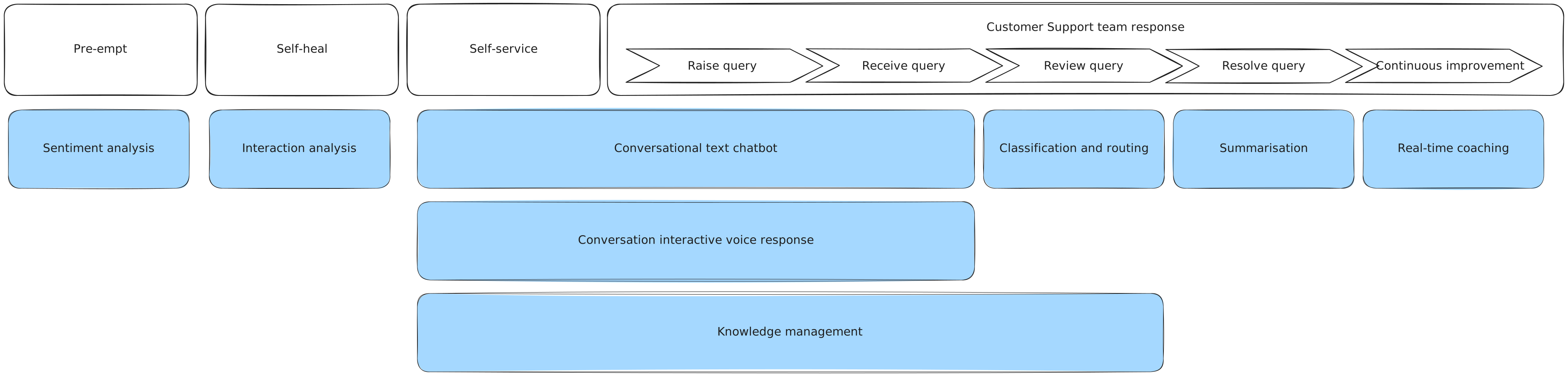
For each use case, we need to classify at least each of the following:
- The value delivered by that use case
- The risk involved with that use case
- The data and technology requirements of that use case
Then, just like any other digital or data transformation, the goal is to sequence these use cases to maximise the value delivered while incrementally building up the data and technology requirements over time to support future use cases. All of this should be done while controlling for risk, which is particularly important in a customer-facing role like the ones being discussed here.
This will often mean that while the actual value is available on the left-hand side of this diagram, it is both easier and lower risk to start delivering use cases on the right-hand side. But even these can release a lot of value while building up the data and tech capabilities to deliver more transformational use cases further down the line.
Conclusion
That's a quick overview of how I would consider the potential for improving customer support using Gen AI. As I said upfront, nothing in this article is particularly new in theory. This just means applying the lessons from previous articles to a new journey with potentially even more value.
Of course, one of the key enablers here is going to be data. If an organisation has built up a mature data architecture, like what I've talked about in previous articles, that will give it a huge head start over others who need to do that foundational work alongside the AI implementation.