
Apple and Taboola
This week, Taboola announced that it had struck a deal to power native advertising within Apple News and Apple Stocks. Initially, I didn't think too much of it; it's been evident for some time that Apple was planning to scale its ad business, and I don't use Apple products, so I don't care.
Then I read this scathing opinion by Om Malik, building on previous criticism that he has levelled at Taboola (the Taboola bit is halfway down the article, but I enjoyed the Twitter part as well). Om knows what he's talking about, so digging into this decision a bit more would be interesting.
What is Taboola?
Paraphrased from their annual report: they partner with 'digital properties' (mainly apps and websites) to recommend editorial content and advertisements on the open web. They do so outside the closed ecosystems Meta, Google, and Amazon provide.
But rather than trying to describe it, the easiest way to understand Taboola is to look at what it does. This is my Yahoo Finance homepage today, and the red box (which I've added) shows an ad selected by Taboola. Roughly one in five of the items in my feed as I scroll down is an ad selected by Taboola. They are technically labelled ads, but they're also clearly designed to blend in with actual news stories.

I knew I'd be able to find a screenshot on Yahoo because, in 2022, they signed a 30-year exclusive commercial agreement with Yahoo to power native ads on all of their digital properties. To demonstrate that I'm not being selective, this image is taken from Taboola's 2023 annual report, i.e. this is what the product is supposed to look like.
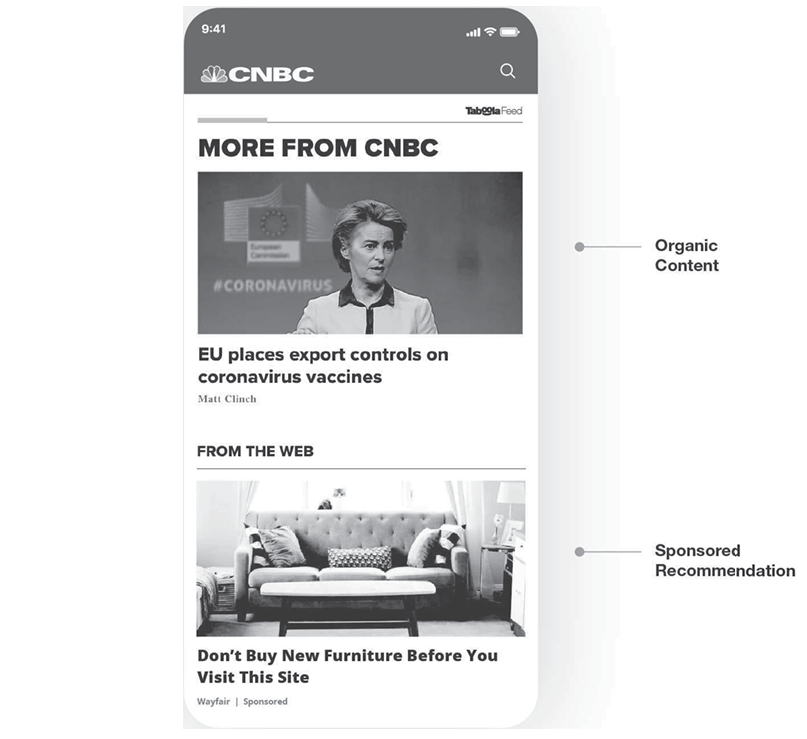
You might form a different opinion, but to me, it looks like Taboola scatters clickbait-y crap all over the internet and tries to make it look, as much as possible, like actual editorial content.
To be clear, I'm not generally negative about targeted digital advertising. High-quality, well-targeted ads that are clearly ads allow me to discover things I might want. They also mean some very valuable services can be offered to me for free. But Taboola's ads seem low-quality, deceptive, and irrelevant.
Now, some, including Taboola, argue that they are providing a source of revenue to platforms that may not survive or at least may have to shrink in size and influence if that revenue wasn't there. I have some sympathy with that. As the CEO of an otherwise dying business, your incentives will lead you to try to make a bit more money in the short term, even if there's a negative long-term impact on the product or service you offer. That's not quite the case for Apple.
Why would Apple do this?
Well, money. That's an obvious answer, but it's still true. Apple's valuation is based not just on current financials but also on future growth. 'Services' are Apple's best hope for a new growth driver, given the already dominant positions of most of their other products and the commercial insignificance of the Vision Pro. The ad business could be a vital component of that revenue.
Apple has been growing its ad business for some time. This has been covered extensively in other places and is old news now. I would recommend Eric Seufert's Mobile Dev Memo to anyone interested, particularly the posts titled "Apple robbed the mob's bank", parts 1, 2 and 3. As a very brief and simplistic recap, Apple launched App Tracking Transparency (ATT) around the same time they started expanding their mobile advertising platform. ATT severely handicapped the way other platforms, particularly Facebook, use data to target consumer ads. By hobbling the competition, Apple enhanced the relative value of its own product. However, as Seufert points out, Meta is such an unsympathetic party that Apple could do this in broad daylight, under the guise of 'user privacy', and no one batted an eye. Somehow even under close and increasing regulatory scrutiny, Apple was free to do something which felt very anti-competitive as long as it was screwing over someone even more unpopular with regulators.
As an aside for anyone who thinks this doesn't matter because who cares whether Apple or Meta gets that money, what played out was precisely what intelligent people like Eric Seufert and Ben Thompson predicted. Meta took a short-term hit while figuring out how to cope with the new environment and is now even more entrenched than ever because very few other companies can jump the hurdles they did. Many small businesses that relied on the old ways of doing targeted advertising and survived because they could run campaigns targeted at a tiny but relevant group of people didn't survive.
All of this is to say that to maintain their share price, Apple needs ad revenue, and they have managed to get away with disguising their moves in this direction so far as user-centric changes to reduce tracking. It seems now they've given up on the disguise. These ads will worsen the affected platforms, Apple News and Apple Stocks. Spend time on Yahoo Finance, and you'll see what I mean. Sure, the Apple implementation might be slightly better, but either way, they're inserting crap into their product, even if their implementation reduces the overall impact of that crap.
To reiterate, I think it's fine to serve ads in these products as long as those are high-quality and relevant ads that, at the very least, do not worsen the user experience. Apple often seems like a company with the resources and perspective to make longer-term decisions for the benefit of its products and end users, which then pays off, ultimately becoming one of the world's wealthiest and most influential companies. That, unfortunately, seems to be the opposite of what's happened here. They've actively decided to make their products worse by smearing them in low-quality, clickbait-y ads, and in doing so, they have signalled an unfortunate prioritisation of money over users.
Does this impact Apple's privacy narrative?
This section was a last-minute addition based on some comments I saw online.
So, on a technical level, no, this does not have any privacy implications. One reason Taboola's ads are irrelevant is that they don't use targeted user data. They are contextual only, and contextual advertising is effective only in a minimal subset of contexts.
But regarding the narrative, yes, this will have an impact. Anyone not thinking about these topics regularly will hear the news that Apple is partnering with an ad network and assume there are privacy implications. I'm surprised the messaging around this wasn't handled more carefully.